


I heard these sounds in September.
Read my latest Listening Journal.
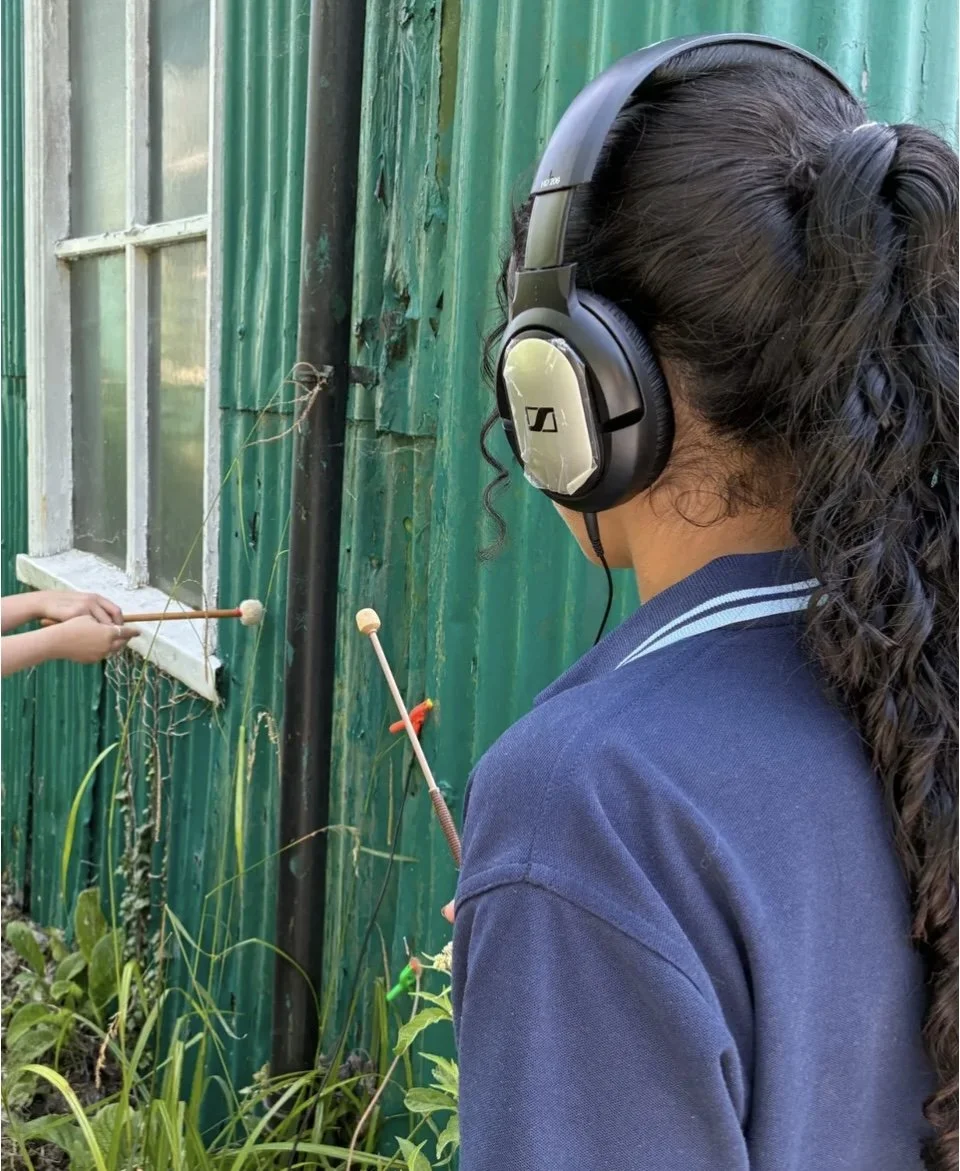
A collaboration with young artists from Lewes Priory and Seaford Head Schools, in partnership with Archaeology South East, UCL, Writing Our Legacy and The Lewes Green Huts Project. Connecting architecture, landscape and colonial legacy through listening.
I’ve fallen a bit behind sharing extracts but these are some things I heard earlier this year.
In my studio I notice the radiator is gurgling like a churning stomach. As I listen more closely I discern three distinct layers of sound.
I heard these sounds in September.
Read my latest Listening Journal.

Listening to stone. Inquisitive about what we might learn from ‘listening in’ and expanding our auditory experience. Stone Tape. Stalactite Organ. Tuning in to materials and connecting on a deeper level. Imagined prehistory ‘sound fabric’. Blake Baxter Detroit Underground Resistance thru sound. Uprising. The submerged surfacing. My beginnings. The landscape listens. Representing the softness and kindness. Struck by the power of my vulnerability. Neolithic Cannibals playing in a dead (acoustic) space. A low hum sat between and under everything. Sharing this with one of the Neolithic Cannibals artists in the audience. A sound community.


I don’t play live very often and when I do the performance is often a one off that I never repeat again. Sometimes I’m frustrated with myself about that (because of the amount of rehearsals) and wonder why I haven’t done more live shows. Through the nerves and anxiety I usually enjoy it and my last show at RIBA, London was probably one of my best experiences of playing live.
It was nice discovering this recording of a live performance (venue and event unknown) using the Buchla Synthesizer and a DIY drum machine and being reminded of the magic of that SF freq machine and how fun it can be to unleash the wildness.
Listen/Buy the Being Bats recording here.

Sound artist Simon James will present works where sound and archaeology converge in an exploration of history and place. His practice involves deep listening to sounds that often go unnoticed, unheard.
Recently, Simon collaborated with a group of young sound artists from Whitehawk and East Brighton on Neolithic Cannibals, a socially engaged sound art exhibition that delves into the rich history of Whitehawk Hill. The Neolithic site overlooks the Whitehawk Estate, as a place of ancient rituals, celebrations and connections.
Simon will share recordings from Neolithic Cannibals, thus offering a glimpse into how sound and listening can serve as a bridge between deep time, the present day and social issues in areas that can be considered hidden and unheard. This will be interspersed with other sound art projects and recordings that similarly draw upon archaeological themes.
Tickets here.
Neolithic Cannibals is a Class Divide production commissioned by Brighton Festival in partnership with Lighthouse, and with support from Archaeology South East and Brighton and Hove Museums.
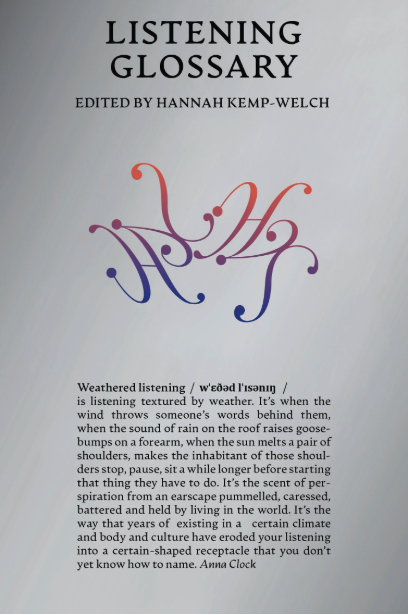
I started a listening journal in September 2023 whilst on a residency in the Pyrenees. It wasn’t my first attempt to make ‘no microphone’* recordings, but it began a sustained period of recording sounds using words. Maybe it’s because it is relatively new compared to recording using microphones, which I’ve been doing for decades, but I’ve found the process has become my favourite way of connecting with listening.
My listening journal comes everywhere with me, and the feeling of opening it up to make a new entry is calming and invites a quiet focus I struggle to find anywhere else. I try to record in the moment rather than from memory, and find that this promotes a deeper listening and connection with the world around me, getting really inquisitive about what I’m hearing; the texture, rhythm, timbre, acoustics, time and spatial dynamics as well as exploring aspects of relationships, memories and place.
There is often no context in entries, just simple noting of things I’ve heard, with an attempt to record something of the character and detail of the sound. Sometimes it is important to describe the sound source and sometimes that won’t be so clear.
This is practice for me. Writing and listening.
I’m going to share extracts each month and begin with August’s recordings. I’m considering a number of bonus/subscriber content ideas including monthly extracts from the past year’s archive and an actual audio recording that accompanies each month’s extracts.
I’d be interested to hear if any of these recordings resonate with you and hope they might invite you to listen to the world in different ways. I owe a huge debt to Pauline Oliveros and other Deep Listening practitioners I’ve been fortunate enough to learn from and good friend and mentor Angus Carlyle, whose writing about sound has been inspirational.
*I read this term for the first time in Dirty Ear Report #2 last week. James Webb uses it to describe pretty much what I’m doing here.
Read MoreA field recording made during the trip to Alness for the Distillation. Yankee Pier juts out in to the Cromarty Firth and was constructed by the US Military in 1917.

Location recording and soundscape composition for Dalmore Whiskey. One of those brilliant projects where my sound art practice meets my commercial work (and not my first Whiskey commission - see here ). Over a year later these sounds still conjure up the smell of whiskey and the heat of the stills. I melted a microphone during this project.

Surround microphone and contact mics attached to the still
Traditional microphones capture the wider soundscape and contact mics listen in to the stills, pipes and other elements of Dalmore Whiskey being produced. It will be at least 10 years before anyone tastes these recordings.
flat top still / condenser / down lyne arm / wash / charging / heating / water jacket / feints / foreshots / middle cut / spirit safe


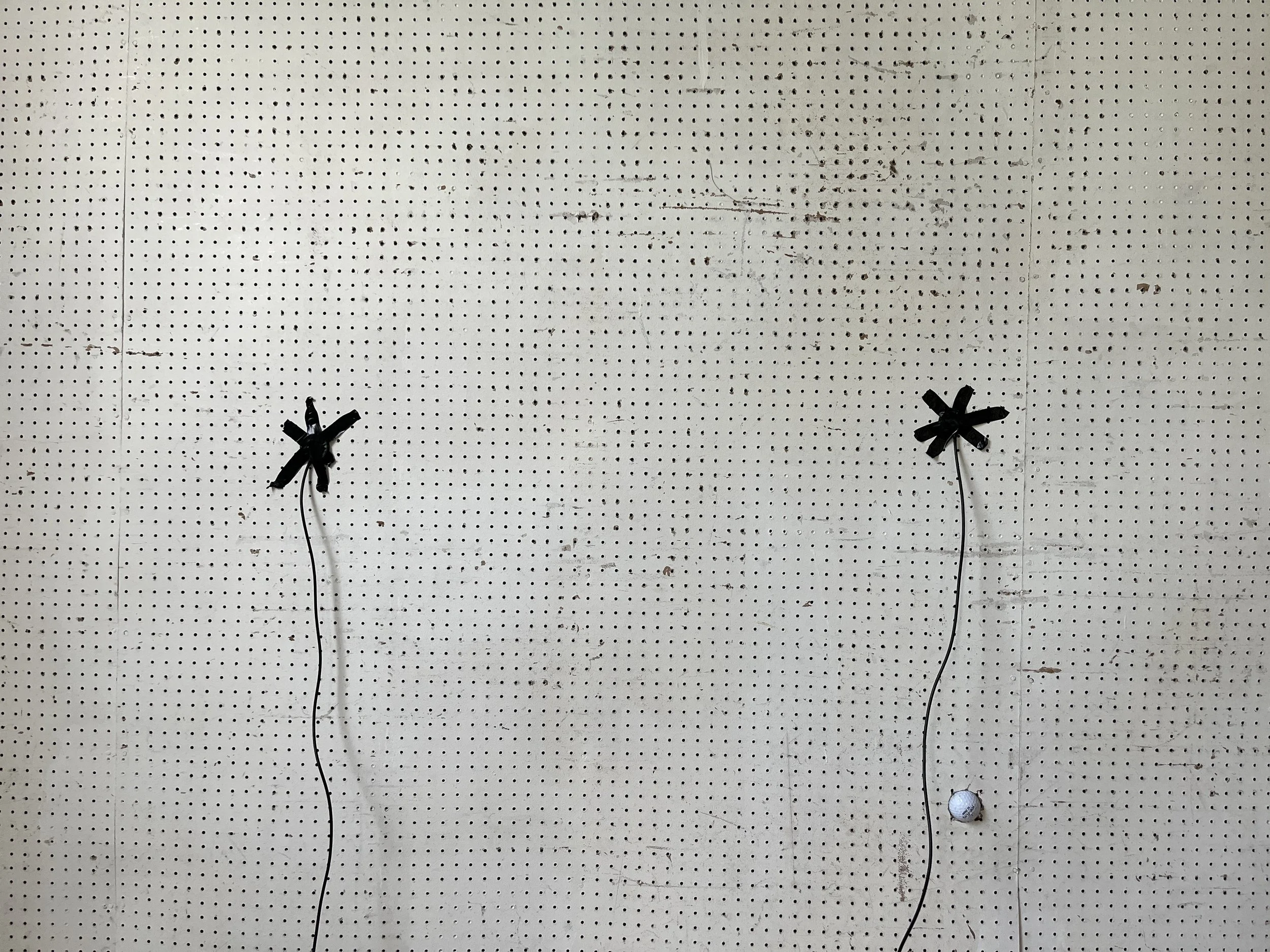
4 day residency with Max de Wardener at Made of Sand in the Blackdown Hills. Tuned microphone and feedback experiments. Recording imprints of the structure. Miniature oscillations. Exposed room tones. Facing speakers to the glass. Excited by spectral falcon wings. Sound wand.
……….
Thanks to Natalie and Tom.


The Neolithic Cannibals exhibition went by in a blur and I need to find some time to write about the experience and think about what it means to my ongoing practice and what I’d like to try and do next. I’m excited. It is one of the biggest (in every sense of the word) projects I’ve been involved with and brings together decades of practice and a new found confidence. I also think we witnessed how powerful a simple invitation to listen can be.
Our plan was to make something uncompromising (in the context of community/sound art). Something that connected the joy of playful creativity, heritage, archaeology, and Class Divide’s campaign for fairer education. There were many times when I thought the story was too complex and had too many layers and wouldn’t work, but listening was the beautiful glue that held everything together. Of course it was.
More thoughts when I have time, but I’m hopeful that there will be more to come.
And I can’t forget those amazing artists I was priveledged to work with and the team at Lighthouse, Emily from Stanley James Press and of course Curtis and Carlie from Class Divide.

The young artists (and one older artist) stand in front of large hanging exhibition banners in the gallery designed by Emily Macaulay.
Photo by Phoebe Wingrove
Workshop 3 was held at Brighton Museum and offered a unique journey into deep history. Exploring the Archaeology Gallery with Jon Sygrave from Archaeology South East, the young artists were transported to the Neolithic era, learning about the remains of Whitehawk Camp while surrounded by mysterious artifacts. With skilled flint knapper Grant Williams the artists experienced the intense sonic impacts and intricate crunchy processes involved in crafting tools from aged stone. It turns out that listening to the materials is of great importance when knapping. Observing the timbral and pitch changes as flint was worked, participants discovered a wide range of sounds within the ancient rock.
Film by Curtis James
Using chalk gathered from Whitehawk Hill, artists translated Whitehawk Neolithic Camp’s patterns and shapes into graphic scores, for future explorations with electronic synthesizers.
The workshop culminated in an improvised performance, where the artists gathered around a mock campfire, exploring the sonic potential of flints and recording their experiments with a surround microphone, capturing every gritty, resonant detail.
Neolithic Cannibals is a socially engaged sound art project and exhibition from the young people of Whitehawk and East Brighton, artist Simon James, who was born and raised in Whitehawk, and Class Divide.
More info here
In workshop 2, the young artists expanded their listening to the outdoors, exploring the sonic environment around The Crew Club. They used portable audio recorders to gather sounds, and percussion beaters were used for improvisation with materials and found objects.
Film by Curtis James
An unexpected highlight was an impromptu group performance playing the railing that surrounds a forlorn and empty playground. Where lack of funds have seen the playpark derelict, the young sound artists found their own way to play, circling the railing and dragging their beaters and brushes over the tines of the railing as they ran around and around. A surround microphone captured the swirling, spinning metallic resonances as they reverberated around the nearby valley walls.
Neolithic Cannibals is a socially engaged sound art project and exhibition from the young people of Whitehawk and East Brighton, artist Simon James, who was born and raised in Whitehawk, and Class Divide.
More info here
The first Neolithic Cannibals workshop took place this week. We enjoyed some simple field recording, exploring the corridor outside our workshop space. I guided the group in listening to and recording the resonances and timbre of various objects and materials such as a hollow plastic bin (which they dropped the microphone in to and then hit with percussion beaters), coathangers sliding and scratching on a metal rail, radiators clanging, squeaky tables and discovering that every door has its own unique sound signature if you listen closely. They mixed these everyday, found sounds with electronics, improvising their first soundscape, each artist engaging with the inquisitive, playful nature that lies at the heart of this project.
Young sound artists take part in listening exercises and experiment with synthesizers and found sounds. Film by Curtis James
“A vibrational movement - through the hill to the city. Vibrating the earth and chalk that sit as a symbolic barrier.”
Often these tools - microphones, synthesisers and effects are more powerful in the hands of young people, with no preconceptions of what they should do with them or what they should sound like. That’s really exciting.
I’m listening back to their work now and there are some lovely moments. After just one session I’ve no doubt we will fill the gallery space with wonderfully imaginative sounds.

At Shoreham Port on the South Coast of England, a harbour arm sits shrouded in mist. A 500hz tone sounds at 2 minute intervals as an alert to those at sea.
In the years I’ve been recording at Shoreham Port I’ve not managed to record the fog horn. Yesterday I was in the right place at the right time and enjoyed listening to the tones from many different perspectives, two of which I’ve shared here.
The main focus of the RIBA exhibition with Jim Stephenson and Sofia Smith was the film, but something that excited me as much as producing my first multi speaker gallery mix was writing the captions for the catalogue. Emily Macaulay, who took care of all the visual branding for the project, suggested we might include some words to accompany the images that make up the bulk of the catalogue. It coincided with a period where I’m actively trying to improve my writing and ways of communicating the listening that I partake in on a daily basis.

Book designed by Emily Macaulay - Photos by Curtis James
I’ve spoken before about my background and lack of education and thus the lack of confidence that historically may have made me feel like I couldn’t do something like this, so I’m really proud to be included in the catalogue.
I’ve kept a listening journal since September 2023 and continue to engage with it daily. The connection and deep noticing this practice promotes has been my favorite discovery for a long time and in fact has seen me do less recording.

A socially engaged sound art project and exhibition at Brighton Festival 2024 from the young people of Whitehawk and East Brighton, and artist Simon James, who was born and raised in Whitehawk and education campaign group Class Divide.
Explored through the deep time history of the Neolithic in East Brighton and the contemporary soundscape of Whitehawk, the Neolithic Cannibals exhibition mixes archaeology, psycho-geography, sound art, and activism to transport audiences to a place where imaginative and fantastical sounds will invite deep listening to an area that can often be considered hidden and unheard.

Through a series of workshops the young people of Whitehawk will listen to and sound the contemporary environment of East Brighton using the Whitehawk Hill Neolithic Camp, discovered in 1929 through a geophysical listening technique known as Bosing, as a symbolic focal point and inspiration for their sonic explorations.
The Neolithic Cannibals exhibition at Lighthouse will recreate the Neolithic Camp - a place of communion, celebration and ritual, as a compassionate listening space inviting audiences to discover Whitehawk's richness, joy, playfulness and hope, empowering local voices through rarely explored sonic expressions. Audiences will leave with a deeper appreciation for empathetic listening, and consider the power of collective effort and the part we all play in addressing complex and current social issues.
I’m doing some early research on a series of short personal radio features and one of them is about a painting that I’d locked away in my loft. I enjoyed reading Oscar Wilde’s The Picture of Dorian Gray and soaking up the atmosphere and exploration of duality and paintings as mirrors.
As a person from a working class background it has taken me a long time to find the confidence to consider telling stories with my own voice, using my own words, accepting my own self percieved lack of vocabulary and inteligence. But I’m excited about the stories I can tell and the creative ways I can shape them, welcoming space and placing deep listening at the center.
I owe a lot to my twin brother leading the way with his podcast series about education inequality which also features some of our childhood experiences. Listen here.
“There were maladies so strange that one had to pass through them if one sought to understand their nature. ”
Jim Stephenson and Sofia Smith’s multi screen film takes a slow motion look at how buildings are used once the architect has left and the glossy photo shoots are complete. After a run at RIBA’s Portland Place gallery, it opens this weekend in Newcastle at the Farrell Centre with my 7.1 multi speaker soundscape.

Sound design and music for Mia Khalifa and Sara Burn’s new jewellery brand Sheytan. A really fun project to work on mixing field recordings and intricate sounds of jewellery and body movements. Direction (from Dom Goodman at Tin Drum, one of my oldest friends from ‘90s streetwear shop The One40Five Store) fitted really nicely with where my head is at right now around subtle, half heard shifts to reality, magical breath, smoke air. The key though was getting the foley sounds of the jewellery and body movements, general atmos and then working out where to shift that scenery.
PHOTOGRAPHER
@Fabienmontique
MOVMENT DIRECTOR
@Harpersletters
ART DIRECTOR
@rupertsmythstudio
CREATIVE DIRECTORS
@saraburnstudio @miakhalifa
PHOTO ASSIST + DOP VIDEO
@skoczkowski
BTS PHOTOGRAPHY
@coralilliana
MODEL
@Aissa.seck
CAMERA ASSISTANT
@thomdfr
PHOTO LIGHT ASSISTANT
@prod109film
@edward_wendt
MAKEUP
@aurelia.liansberg
HAIR
@jacobkajruphair
STYLING ASSISTANT
@cocoblossomdawson
PRODUCER
@montiqueandco
@Jonas_prod
ASSIST PROD
@It_sangie
MUSIC SUPERVISION
@Dominic.goodman for @tindrummusicuk
SOUND DESIGN
@thesimonsound
LOCATION
@Studio.labriquerouge
Highs in the Pyrenees at Camp Fr.

I headed down to Shoreham Port this morning to do some listening. I took microphones but I had no real intention of recording. As I passed the Lagoon to the East and turned the corner on Basin Road, the familiar overpowering odour of fish from the fishing boats and dock hit my nose. I’m not a fan of fish, my memory of living in a council flat and the communal areas stale with the stench of a neighbour’s fishy dinners putting me off for life. Usually I hold my nose and walk briskly past, but today it struck me that this space is full of smells and how I’ve never fully turned my attention to them.
As I pass the fishing docks I picked up a smell from the building on my left, large air vents blowing out warm musty air that smells of bland dust. I walk on and sniff bouncy, rubbery clouds floating from the bicycle workshop.
Loud trucks pass me, exhausts spewing diesel fumes. In contrast, distant but growing is my favourite smell of timber shipped from Europe for local building work. It is an evocative smell and reminds me of walking in woods and forests. It mixes with the fresh air blown off the sea.
It’s quiet down here today but I pass a few people and pick up the scents of their soaps and deodorants. Clean, sweet fragrances that cut through the industrial haze. Next a hot, burnt scent - toxic. I think it is the fumes from the old gas works. Oil seeped in to the ground gets churned up by rough seas. On the road the sea scent is faint. I have to draw in deeply to pick it up.
Sound from a machine on the docks bounces off the sea wall throwing it’s location and confusing me. Smells do the same. Some are just out of reach. I can’t quite take enough in to establish what they are. They sit on the periphery of knowing.
A single cormorant sits on the cold pipe warning light.
My nose is already preparing for the water treatment plant, and it hits me before I’ve even crossed the road. I’ve described this stench as a mix of shit and washing detergent. A trace of perfume from a passing walker cuts through the stink for a moment. It is a welcome relief but I let them go by as I don’t want their scent trail to cloud the natural and unnatural smells here.
The whiff of freshly caught fish from a family set up with tents and multiple fishing rods. Two young men stand on a wooden groyne and leap in to the sea. I can smell sun tan lotion and more human odours as I approach Carrats Cafe. Fruity shower gels and clean deodorants. Hot oil, fried foods and coffee.
Smells are similar to sounds in that they are carried in the air, sometimes fleeting, difficult to place; sometimes loud and obnoxious, sometimes actually noxious. As I turned my attention to smelling I realised how easily confused I became and wondered sometimes if I was imagining smells - scent memories triggered by certain conditions.